Ever looked at a quote from a marketing agency and felt a knot form in your stomach? You’re not alone. The numbers can look wild, and the hidden fees are even wilder. In the next few minutes we’ll walk through the seven cost factors that decide whether a subscription‑based agency like Long Weekend or an in‑house squad makes sense for you. You’ll see where money slips away, where value hides, and how to pick the option that keeps your budget on a leash.
1. Agency Monthly Retainers
Most agencies sell their services as a monthly retainer. The price tag can sit anywhere from a couple of thousand dollars up to five‑figures. The spread isn’t random , it mirrors the depth of work, the talent level, and the market the agency serves.
At the low end (roughly $2,500‑$3,000 a month) you get a junior specialist who sets up your Google Ads campaigns, makes occasional bid tweaks, and hands you a simple report. Expect about 10‑15 hours of work. The strategy is generic, built from templates that work for many businesses.
Mid‑range retainers ($3,000‑$10,000) bring a dedicated account manager, custom strategy sessions, and dee. You’ll see 20‑40 hours of expert time each month, plus regular performance reviews. Agencies in this tier usually have a track record in your industry and can fine‑tune campaigns to beat local competition.
Enterprise‑level retainers start at $10,000 and can climb much higher. This tier delivers a full‑stack team: strategists, creatives, data scientists, and a reporting dashboard that feels like a second brain. They handle multiple channels, run advanced A/B tests, and act as an extension of your business.
Why does geography matter? An agency in New York carries higher office rent and talent costs, so they pass that on. A boutique shop in a smaller market may charge less, but they might lack the heavy‑duty tools you need for a competitive niche.
Industry competitiveness also drives price. A personal‑injury lawyer faces $50‑$150 per click, so the agency must dedicate more research and tighter budget control. That expertise justifies a higher retainer.
Scope of services is another lever. Some agencies bundle SEO, PPC, landing‑page design, and conversion‑rate work into one fee. Others charge each piece separately, making apples‑to‑apples comparison tough.
And here’s a reality check: a $1,200 retainer may look cheap, but if the agency can’t keep your ad spend efficient, you’ll waste more than you saved. The opportunity cost of a half‑year with a weak partner can eclipse the retainer itself.
When you write that check, ask where the money goes. A solid retainer should cover:
Strategic research and audience mapping
Ongoing campaign management and bid optimization
Creative copy or asset production
Transparent reporting with ROAS metrics
Continuous testing and conversion‑rate tweaks
Notice the focus on results, not just hours.
Key Takeaway: A higher retainer usually means deeper expertise, more hours, and a broader service suite , the trade‑off is predictability versus raw price.
For a real‑world example, a Cleveland‑based SaaS startup swapped a $2,500 retainer for Long Weekend’s subscription model. Within three months they saw a 45% lift in qualified leads while the monthly spend stayed under $4,000. Wikipedia’s definition of a marketing agency confirms that agencies vary widely in scope, so the retainer price is a proxy for the scope you’ll actually get.
2. In-House Salary Costs
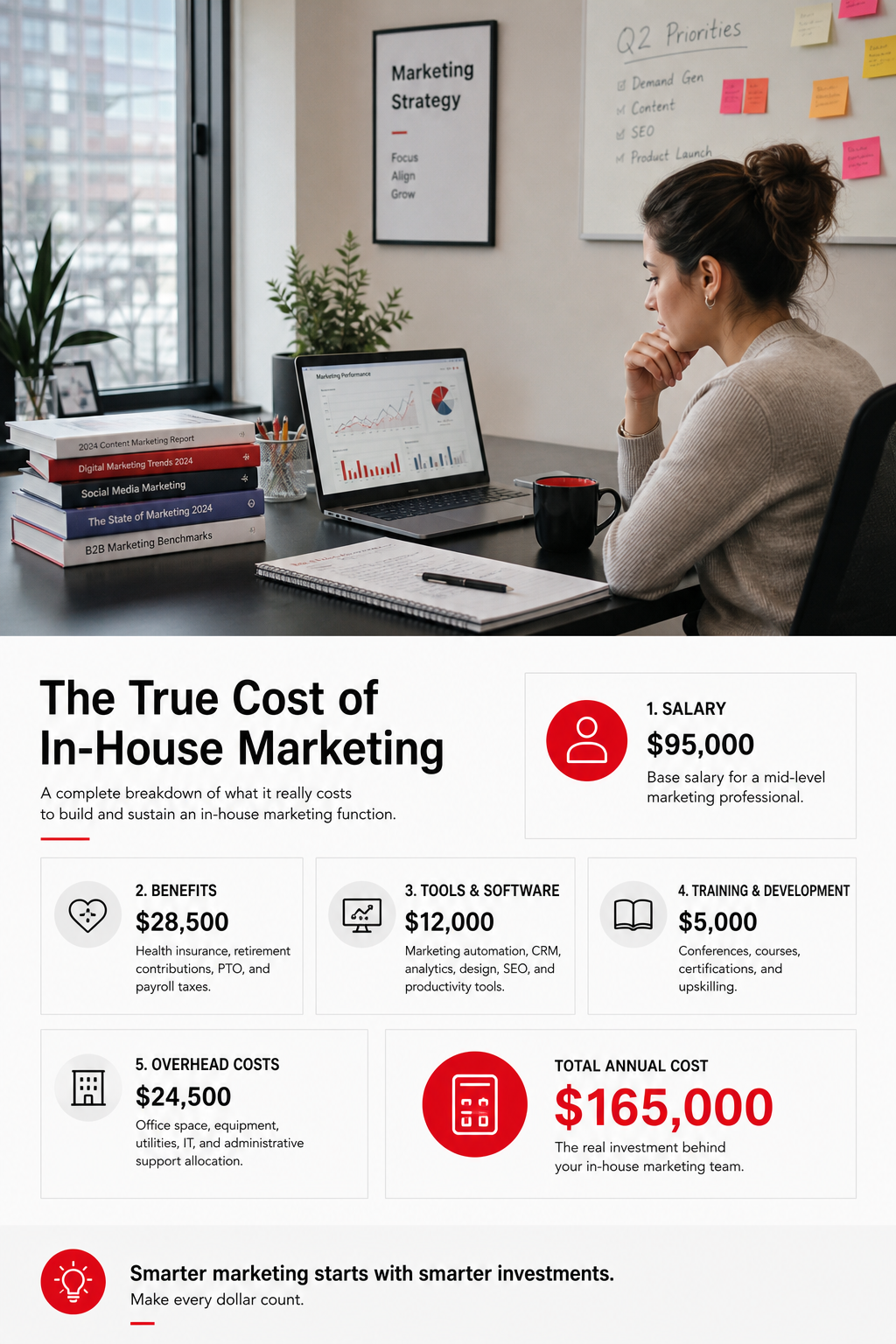
Hiring a senior marketer can feel like buying a race car. The headline salary range runs from $222,300 to $587,000 per year, with an average of $404,650 s.
But the salary is just the tip of the iceberg. Add employer taxes (about 7‑10% of wages), health benefits (often $8,000‑$15,000), paid time off, retirement contributions, and workers’ comp. Those “burden” costs push the real cost up another 30‑50%.
Next, factor in the tools your employee needs. A laptop, a design suite, analytics platforms, and a CRM can easily cost $500‑$2,000 each month. If you need SEO tools, email automation, and a social‑media scheduler, you’re looking at $1,000‑$2,000 extra per month.
Training and professional development are also non‑negotiable. Marketing trends shift fast, and keeping skills sharp means courses, conferences, and certifications that add $2,000‑$5,000 a year per person.
Management overhead is another hidden line item. Someone has to set goals, review work, and coordinate with other departments. If a senior leader spends 5 hours a week on this, at a $150 hourly rate that’s $3,000 a month in indirect cost.
Recruitment and turnover can wipe out months of budgeting. The average time to fill a senior role is 60‑90 days, and the cost of a bad hire can reach $30,000‑$50,000 when you add lost productivity and re‑training.
All of this adds up fast. Let’s run a quick spreadsheet example. Start with a $120,000 base salary. Add 8% tax ($9,600), 12% benefits ($14,400), 10% tool spend ($12,000), 4% training ($4,800), and 5% management time ($7,200). The total annual cost climbs to $167,000 , a 39% increase over base pay.
Here’s a visual snapshot of where the money goes:
Even with a lean team, you’ll likely need at least three specialists , a strategist, a content creator, and a performance marketer , to cover the full funnel. That multiplies the cost quickly.
Long Weekend’s subscription model sidesteps these hidden expenses. For a flat monthly fee you get a full team that covers strategy, creative, paid media, and reporting , no payroll, no benefits, no tool stack to buy.
According to the U.S. Bureau of Labor Statistics, the median wage for marketing managers in 2026 was $135,000, but the total employment cost is higher when you factor in the elements above BLS data. That aligns with the research hook that senior in‑house marketers can command up to $587,000 a year.
3. Agency Project‑Based Fees
Not every marketing need fits a monthly retainer. Some businesses prefer a one‑off project , a brand overhaul, a website launch, or a seasonal campaign. Project fees can range from $20,000 to $500,000 or more.
The price hinges on three variables:
Scope , how many deliverables (e.g., logo, brand guide, website, ad creative)
Complexity , industry competitiveness, research depth, stakeholder interviews
Agency tier , boutique vs. full‑service, AI‑enabled vs. traditional
Onboarding is often the first hidden charge. Agencies spend time learning your business, and that cost can sit between $10,000‑$20,000. Some agencies bake it into the hourly rate; others list it as a separate line item.
Technology fees follow. If the agency uses premium tools like design software, analytics platforms, or data visualization tools, you may see a $200‑$20,000 charge, depending on licensing and duration.
Media spend markup is another piece of the puzzle. Many agencies take 3‑15% of your ad budget as a handling fee. So a $100,000 media spend could add $3,000‑$15,000 to the overall cost.
Change orders can pop up when the project scope shifts , a new landing page, extra copy, or additional market research. Those tweaks usually cost 10‑20% of the original fee per change.
Let’s break down a typical rebranding project:
Research & discovery: $15,000
Strategy development: $10,000
Creative design (logo, visual system): $25,000
Website build: $40,000
Launch & training: $5,000
Agency profit margin: $15,000
Total: $110,000. If you tried to replicate this in‑house, you’d need a senior designer, a copywriter, a developer, and a project manager , each pulling a six‑figure salary plus overhead.
Pro Tip: Before signing, ask for a detailed deliverable list and a per‑output cost breakdown. This reveals whether you’re paying for hours or for tangible results.
Long Weekend offers a hybrid option: you can add a project‑based sprint on top of the subscription, letting you get a brand refresh without hiring a full‑time designer.
In practice, a mid‑size e‑commerce brand used a $45,000 rebrand project from an agency, then switched to Long Weekend’s managed service for ongoing growth. The combined spend stayed under $7,000 per month, yet the brand’s revenue grew 28% YoY.
4. In-House Overhead and Tools
Beyond salaries, your in‑house team drags a raft of ongoing expenses. Office space, utilities, and furniture can easily run $5,000‑$10,000 a year per employee. Those costs rise if you need a dedicated studio for video production or a high‑speed internet line.
Software licenses are a major line item. A typical marketing stack includes:
SEO platform (e.g., top-tier SEO tool), $200‑$300 per month
Email automation (e.g., leading email platform), $150‑$250 per month
Social-media scheduler (e.g., popular scheduling tool), $100‑$150 per month
Analytics and reporting (e.g., dashboard and BI tool), $0‑$500 per month
Design suite (e.g., professional design software), $80‑$100 per month
Multiply that by the number of users, and you’re looking at $1,000‑$2,500 a month just to keep the tools humming.
Data storage and backup also add cost, especially if you handle large media files. Cloud storage can be $100‑$300 a month for a mid‑size team.
Don’t forget compliance and security. GDPR‑ready tools, a VPN service, and regular security audits can add another $500‑$1,000 annually.
All of these line items stack up, turning a seemingly simple hire into a multi‑dimensional budget.
Long Weekend’s subscription bundles most of these tools , we pay for the SEO platform, the ad‑tech stack, and the reporting dashboard, then pass the benefit to you at no extra charge.
For a concrete comparison, a tech startup in Cleveland built an internal team of three marketers. Their tool spend hit $2,400 a month, office rent $1,800, and utilities $300. Add the $15,000 annual software renewal for a design suite and the hidden overhead tops $25,000 in the first year , before you even count salaries.
Here’s a quick matrix that shows where the money goes:
Expense Category
Monthly Cost (Avg.)
Notes
Office Space & Utilities
$200‑$400
Depends on location and size
Software Licenses
$1,000‑$2,500
SEO, email, design, analytics
Data Storage
$80‑$150
Cloud backup for media assets
Compliance & Security
$40‑$80
VPN, audits, GDPR tools
Misc. Overhead
$150‑$300
Office supplies, snacks, etc.
When you add these to the salary burden, the total cost of an in‑house marketing engine can easily exceed $250,000 a year for a modest team.
SEO / AIO Optimization at Long Weekend bundles many of these tools into a single subscription, keeping your overhead predictable.
5. Hidden Costs of In-House Teams
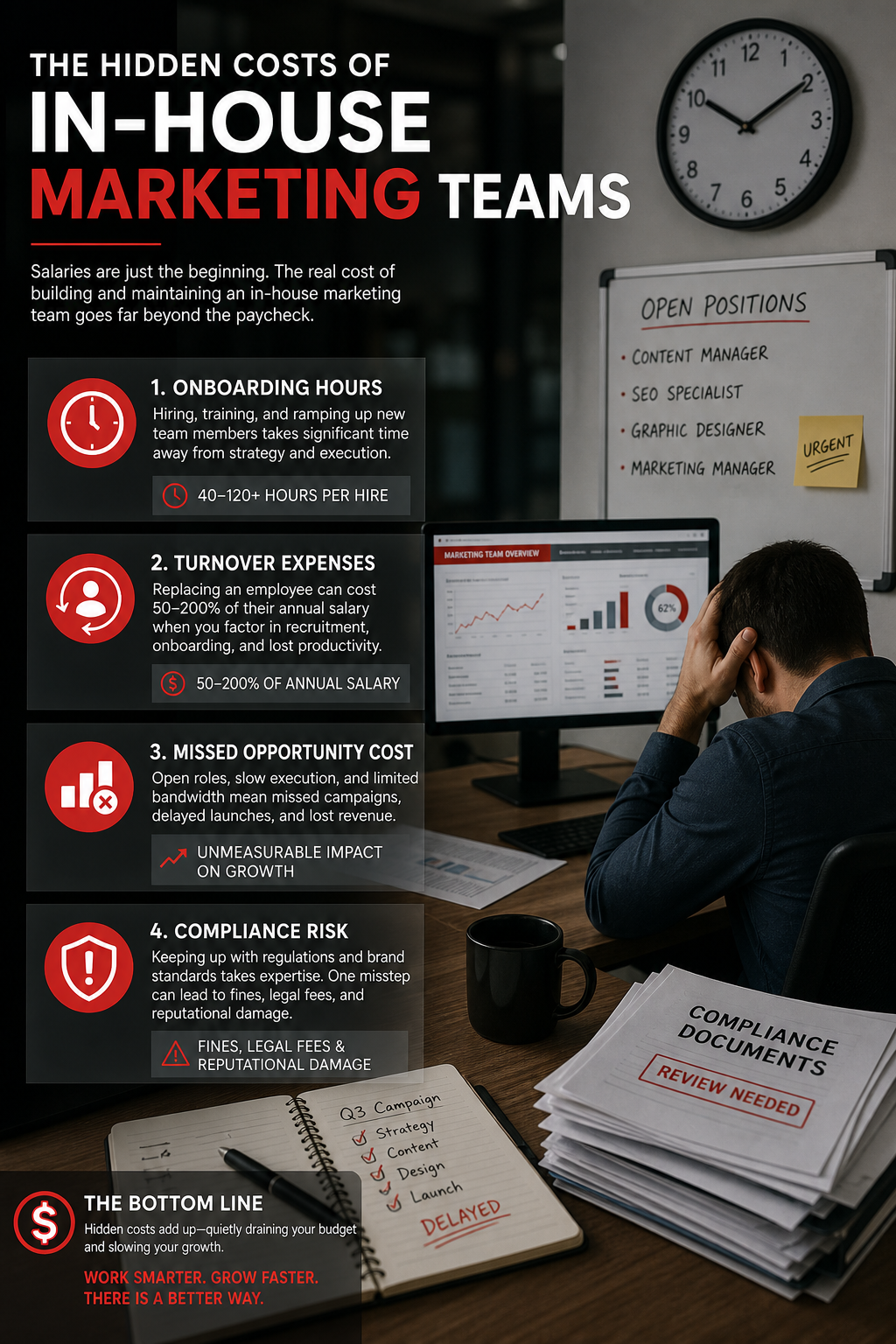
Some costs don’t appear on a spreadsheet until they bite you.
First, onboarding time. A new hire needs weeks of training, shadowing, and access setup. During that period, productivity is low, and senior staff spend extra hours guiding the newcomer.
Second, knowledge silos. If only one person knows how to run a specific campaign, their absence can halt progress. Cross‑training costs time and money, but it’s essential for resilience.
Third, turnover churn. When a marketer leaves, you lose not just their salary but also the institutional knowledge they built. Recruiting, interviewing, and onboarding a replacement can cost $15,000‑$30,000 per person.
Fourth, missed opportunities. An in‑house team may lack the breadth of experience that an agency brings from working with dozens of clients. That can translate into slower adoption of new channels, less creative experimentation, and ultimately lower ROI.
Fifth, internal politics. Aligning marketing goals with sales, product, and finance often requires extra meetings, revisions, and compromise. Those coordination costs are real but hard to quantify.
Sixth, compliance risk. If your team mishandles data privacy or runs ads that violate platform policies, you could face fines or account suspensions , a cost no one wants.
Here’s a snapshot of hidden costs for a 2,500‑person firm that tried to keep everything in‑house:
Imagine you spend $150,000 on salaries, $30,000 on benefits, $20,000 on tools, and $10,000 on office space. Add another $25,000 in hidden costs and you’re looking at $235,000 total , a 57% increase over the base salary alone.
Long Weekend’s model removes many of these hidden line items. Because we already own the tools, the talent, and the compliance frameworks, you pay a flat fee and avoid the surprise expenses that creep up in an internal setup.
6. Long‑Term Cost Implications
When you zoom out, the decision becomes a Total Cost of Ownership (TCO) problem.
Agencies spread their fixed costs across many clients, which often means lower per‑client overhead. Their fees include staff salaries, tools, and even the occasional travel expense, all bundled into the retainer.
In‑house teams bear 100% of those costs, regardless of how much work you have in a given month. During slow periods, the payroll still runs, and you may end up with idle capacity.
However, agencies charge a markup on media spend (typically 3‑15%). If your ad budget is modest, that markup can be a sizable percentage of your total spend. In contrast, an in‑house media buyer would use the entire budget for media, but you still have to pay the buyer’s salary.
Scalability matters too. As your business grows, an agency can quickly add more resources , they already have a bench of specialists. Expanding an internal team requires hiring, training, and new office space, which can take months.
On the flip side, an agency’s profit motive pushes them to deliver measurable ROI. If they can’t, you can walk away at the end of a contract. An internal team may have less external pressure to optimize, which can lead to complacency.
"The biggest mistake is counting only salary. True cost includes HR, tech, and opportunity loss," says a senior analyst at a marketing consultancy.
For a B2B SaaS that spends $15,000 a month on ads, an agency retainer of $5,000 plus a 5% media markup ends up at $5,750. An in‑house marketer earning $120,000 a year costs roughly $165,000 total, or $13,750 a month , more than double the agency route.
Long Weekend’s subscription starts at $3,500 a month for a full suite of services, which includes the media markup in the fee. That keeps the TCO low while still giving you access to senior talent.
7. Hybrid Approach: Getting the Best of Both
Many companies find a hybrid model works best. They keep a small core team for brand stewardship, quick wins, and internal data, and they partner with an agency for heavy lifting, specialist projects, and scale.
Typical hybrid setups look like this:
Core team (2‑3 people) handles day‑to‑day content, basic SEO, and internal approvals.
Agency provides strategy, advanced SEO, paid‑media management, and creative production.
Access to agency‑level expertise without full‑time cost.
Flexibility to ramp up agency hours during growth spikes.
Challenges are coordination and clear ownership. You need a solid SLA and a single point of contact to avoid duplicated effort.
Our own clients often start with Long Weekend’s subscription, then add a few internal hires as they scale. The result is a lean team that pays for only what it needs, while the agency covers the heavy technical work.
Model
Typical Monthly Cost
Pros
Cons
Pure Agency
$4,000‑$10,000
Predictable spend, full expertise
Less brand control, markup on media
Pure In‑House
$15,000‑$30,000
Direct oversight, data ownership
High fixed cost, hiring risk
Hybrid
$8,000‑$18,000
Balanced control, scalable, cost‑effective
Requires strong coordination
When you weigh the seven cost factors, ask yourself:
Do I need full‑time expertise, or can I buy it as needed?
How volatile is my marketing spend?
Am I comfortable managing the hidden overhead of an internal team?
If the answers point to flexibility and predictability, Long Weekend’s subscription is the safest bet.
Pro Tip: Run a 12‑month TCO model that adds salary, benefits, tools, and hidden costs. Compare that to the agency’s flat fee plus media markup. The side‑by‑side view often reveals the hidden savings.
FAQ
What’s the biggest hidden expense when hiring an in‑house marketer?
The biggest hidden expense is the total burden cost , taxes, benefits, training, and equipment. A $120,000 salary can swell to $167,000 once you add a 30‑40% overhead, which many businesses overlook when they compare raw salary figures.
Can I mix a retainer with project‑based work?
Yes. Many agencies, including Long Weekend, let you keep a base retainer for ongoing management and add a project‑based sprint for a brand refresh or a new product launch. This hybrid billing keeps monthly spend stable while letting you tackle big initiatives.
How do agency retainers handle media‑spend markup?
Most agencies add a 3‑15% fee on top of your ad budget to cover platform fees, reporting tools, and their own handling costs. The exact percentage varies by agency size and the media channel you use.
Is a hybrid model more expensive than a pure agency?
Not necessarily. A hybrid model can cost less if your core team handles low‑effort tasks while the agency focuses on high‑value work. The key is to define clear responsibilities and avoid duplicate effort.
Do I need to purchase my own marketing tools if I work with an agency?
Usually not. Agencies include tool costs in their retainer or project fee. That’s why agencies can spread the expense across many clients, giving you a lower per‑client price.
How can I estimate the ROI of an agency versus an in‑house team?
Start with a TCO model that adds salary, benefits, tools, and hidden costs for an internal team. Then calculate the agency’s flat fee plus any media‑spend markup. Compare the two against expected revenue lift or lead generation to see which option offers better return on investment.
Key Takeaway: Look beyond the headline price. Factor in salaries, benefits, tools, hidden overhead, and long‑term scalability to truly compare agency versus in‑house costs.
Ready to stop guessing and start seeing real numbers? Try Long Weekend free → Our subscription gives you a full marketing team without the hidden costs of payroll, tools, or office space.
In the end, the choice comes down to your budget, growth speed, and how much control you need over brand and data. If you want predictable monthly spend, instant access to senior talent, and no surprise fees, the agency subscription wins. If you have deep brand intimacy needs and the cash to cover full‑time salaries plus overhead, an in‑house team can work. Most mid‑size businesses find a hybrid model delivers the best balance of cost, expertise, and agility.
Take the next step today. Start your free trial with Long Weekend and see how a subscription‑based model can simplify your marketing spend while delivering the results you need.
Looking for the right digital marketing agency for your business — one that drives measurable ROI? Long Weekend helps service businesses, SaaS, ecommerce brands and more — grow with expert SEO, AI Search, Google Ads (PPC) management, paid social ads, website design, and more.